Cytogenetics Learning Hub
Free guides and worked cases for students, trainees and laboratory professionals learning chromosome analysis, from reading G-bands to writing ISCN.
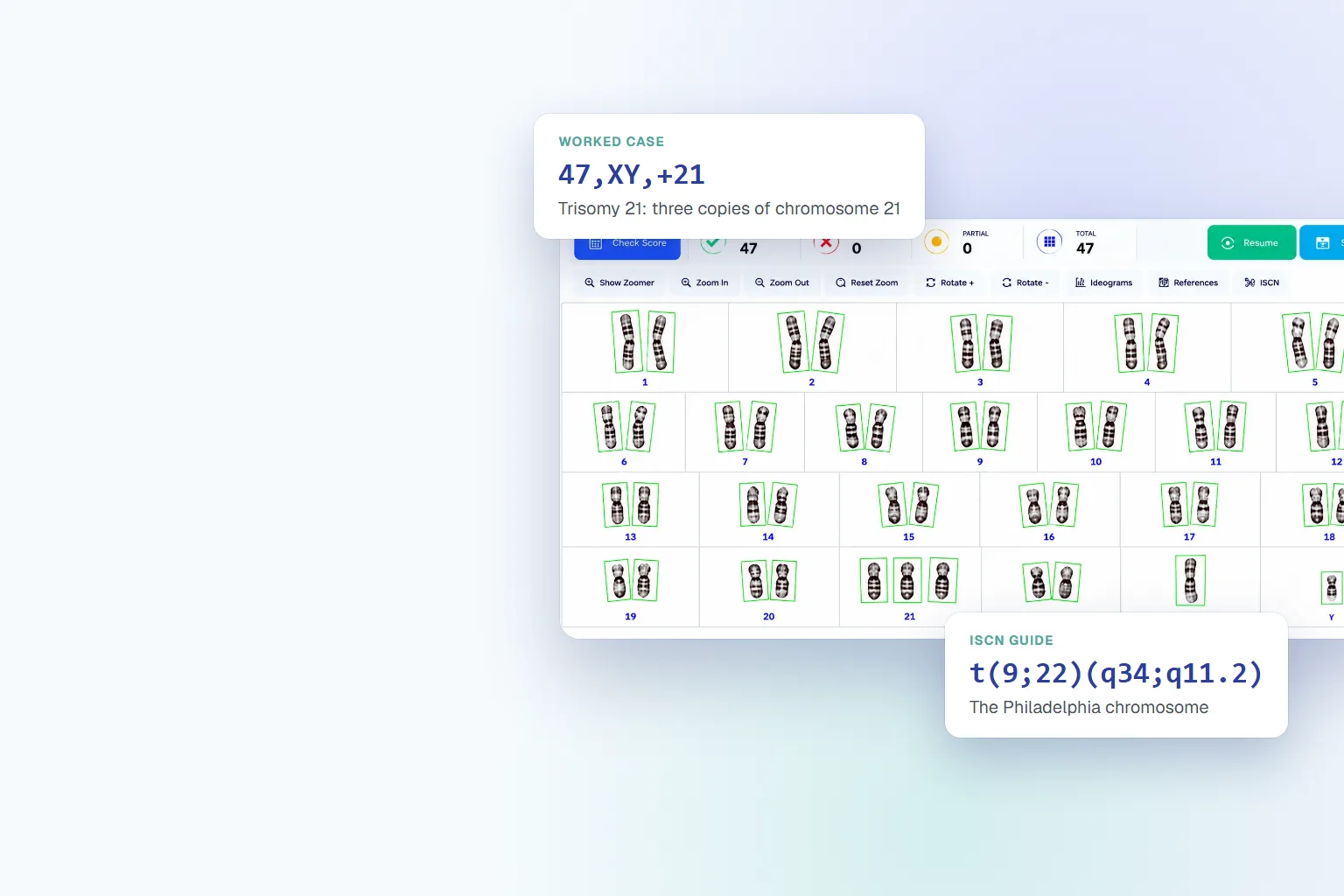
Free guides and worked cases for students, trainees and laboratory professionals learning chromosome analysis, from reading G-bands to writing ISCN.
Start here if you are new to chromosome analysis, or keep them open as references while you practice.
The full workflow from a G-banded metaphase to a written ISCN result, with the mistakes trainees make most often.
Read the guide →The landmark bands for every chromosome, and how to tell apart the pairs that look alike.
Read the guide →How to read and write karyotypes, with worked numerical, structural, mosaic and cancer examples.
Read the guide →What to study for CG(ASCP), an eight-week plan, and the abnormalities you must know.
Read the guide →Worked sample cases with answers, and how to practice so that your accuracy improves.
Read the guide →Each case explains the ISCN result, what to look for at the microscope, and the related karyotypes you are likely to meet.
Three copies of chromosome 21. The most common autosomal trisomy in live births.
47,XY,+18Three copies of chromosome 18. Telling 18 from 17 is the key skill.
47,XX,+13Three copies of chromosome 13. Sorting the D-group acrocentrics is the key skill.
45,XA single X chromosome. Counting carefully and looking for mosaicism are the key skills.
47,XXYAn extra X chromosome in a male. Telling the X from chromosome 7 is the key skill.
t(9;22)(q34;q11.2)The hallmark translocation of chronic myeloid leukemia, in a bone marrow karyotype.
Pick the path that matches where you are.
Karyotutor lets you count, pair and arrange chromosomes from real G-banded metaphase spreads, write the ISCN result, and get every placement scored instantly.
Start Practicing Free Free trial. No card required.